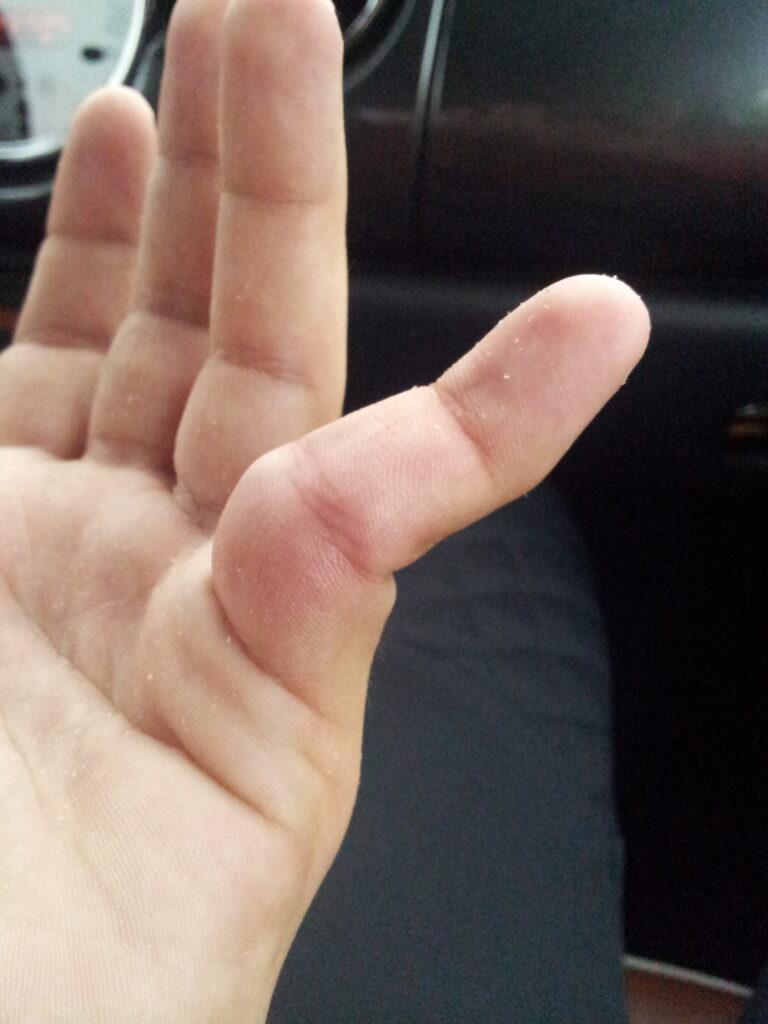
It doesn’t take a great deal to dislocate your finger. A ball hits your hand the wrong way. You trip and instinctively reach out to catch yourself. You slam your finger in a door. Suddenly, things don’t look quite right. Your finger is bent at an odd angle, swelling quickly, and moving it sends a sharp reminder that something isn’t OK.
Before you assume it’s “just jammed” — or panic that it’s broken — let’s break down what the injury really means, and when you should visit urgent care for a dislocated finger.
What Is a Dislocated Finger?
A dislocated finger happens when one of the bones in your finger is forced out of its normal position at the joint. The joint surfaces are no longer aligned properly, which can stretch or tear surrounding ligaments.
Dislocations commonly occur at:
- The joint closest to the fingertip.
- The middle joint.
- The knuckle joint (where the finger meets the hand).
Unlike minor sprains, a true dislocation involves a visible shift in the joint’s position.
Dislocated or Broken? What’s the Difference?
It’s easy to confuse the two, but they’re different injuries:
With a dislocated finger:
- The bone is out of alignment at the joint.
- The finger may look crooked or visibly displaced.
- Movement is often restricted or locked.
- You may feel instability at the joint.
- Sharp pain and swelling are immediate.
- There may be numbness and bruising.
With a broken or fractured finger:
- The bone itself is cracked or fractured.
- The finger may not appear dramatically crooked.
- There is often deep, throbbing pain.
- Swelling and bruising may develop gradually.
- Movement may still be possible — but painful.
In some cases, a dislocation and fracture can happen at the same time. That’s why an X-ray is important — it confirms exactly what kind of injury you’re dealing with.
Common Causes of Finger Dislocation
Finger dislocations are common in both sports and everyday life. They often result from:
- Catching a ball awkwardly.
- Falling onto an outstretched hand.
- Contact sports collisions.
- Workplace or household accidents.
- Slamming a finger in a door.
- Sudden twisting or forceful impact.
Because fingers absorb force easily, they’re vulnerable to sudden trauma.
When to Go to Urgent Care for a Dislocated Finger
It’s important not to attempt to force the finger back into place yourself, as this can worsen damage to ligaments, nerves, or blood vessels.
- Urgent care is often the appropriate first stop if:
- The finger appears visibly out of alignment.
- Swelling and pain are significant.
- You cannot move the finger normally.
- There is no open wound or severe bleeding.
- You need an X-ray to rule out a fracture.
At FirstCall Medical Center, we can quickly evaluate your injury and determine whether the joint can be safely realigned.
Go to the ER immediately if:
- The bone is protruding through the skin.
- There is heavy bleeding.
- The finger appears cold, pale, or blue.
- You have significant numbness or loss of circulation.
- The injury occurred during major trauma.
These signs may indicate vascular damage or a complex fracture requiring emergency care.
How FirstCall Medical Center Can Help
At FirstCall Medical Center, we treat finger dislocations and other minor orthopedic injuries on a walk-in basis. Our team can:
- Perform on-site X-rays.
- Safely realign the joint when appropriate.
- Provide splinting or immobilization.
- Offer pain management guidance.
- Refer to an orthopedic specialist if necessary.
Prompt treatment reduces swelling, protects joint stability, and helps prevent long-term stiffness.
A finger that looks “off” shouldn’t be ignored. Whether it’s dislocated, fractured, or both, early evaluation makes a difference. If your finger is visibly misaligned or won’t move properly after an injury, urgent care can help get it safely back in place.
FirstCall Medical Center is here to help you get back to normal — one joint at a time.